
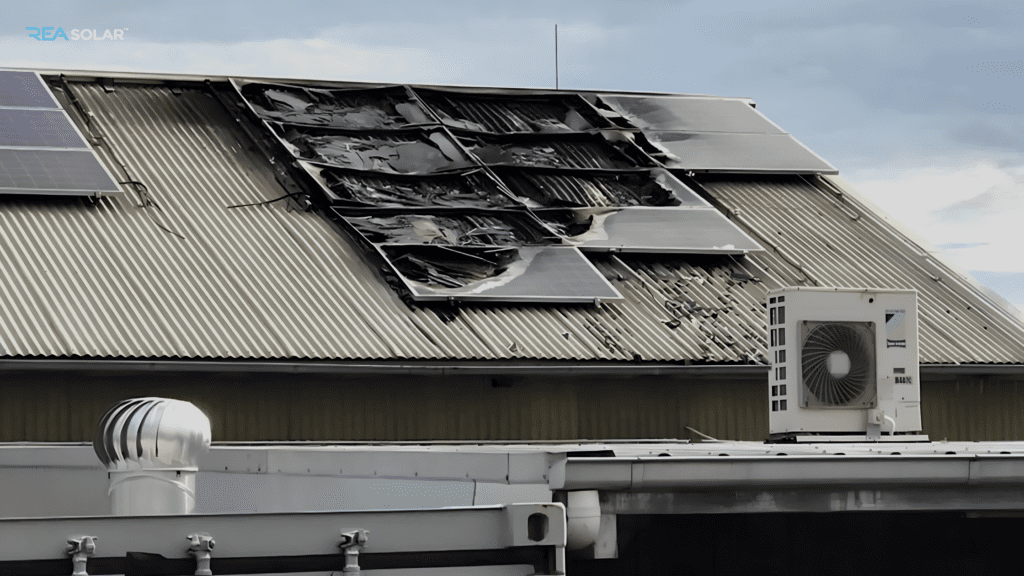
Short answer: solar panel fire safety is worth taking seriously, but PV fires are uncommon against the number of systems running safely across Australia. Most incidents trace back to installation work, connections, or ageing components rather than panels failing on their own, which means the risk is largely manageable.
We install and service systems around Redland Bay, greater Brisbane and out to Toowoomba, so this comes up fairly often. Here’s what’s actually going on.
What “Solar Panel Fire Risk” Actually Means
When people talk about solar panels and fire risk, they’re usually lumping together four different things: the panels, the DC wiring and connectors, the inverter, and increasingly the battery. Each has a different risk profile, and treating them as one “solar fire” issue makes the picture look worse than it is. A correctly installed system has built-in layers of protection. Fires happen when one of those layers is compromised, usually through poor workmanship, damage, or components that were never suited to the job.
What The Australian Picture Actually Looks Like
Australia doesn’t currently have a single comprehensive dataset covering rooftop solar fires across every state and territory, so there isn’t one reliable national figure for how many occur each year. State-level data, however, gives us a useful picture of what is happening.
In Victoria, Energy Safe Victoria (ESV) investigated 53 rooftop solar-related fires during the 2022–23 financial year, up from 28 the year before. Its investigations identified moisture affecting DC isolators as a major issue.
DC isolators are installed outdoors, where they’re exposed to heat, UV, rain and moisture year after year. Around Christmas 2022, ESV investigated three house fires involving solar systems that were five, seven and ten years old. All three were traced to faulty or malfunctioning DC isolators. The incidents were also covered by electrical industry publications at the time.
More recently, ESV reported 138 solar-related house fires over the three years to September 2025, again highlighting the importance of having older systems inspected and serviced.
Overseas data points in a similar direction. Insurer QBE analysed UK fire-service data and found 212 fires involving solar panels in 2025, compared with 91 in 2022. DC cabling and connectors were the most commonly identified cause. These are UK figures, not Australian ones, but they highlight an important point: fire risks can involve the electrical connections and components around a solar system, not just the panels themselves.
For Queensland homeowners, the takeaway is simple: if your solar system is several years old, don’t assume everything is fine just because it’s still producing power. Having the system checked by a licensed professional can help catch problems with isolators, cables, connectors and other components before they become a bigger issue.
Solar fire safety isn’t about being afraid of solar. It’s about treating a rooftop solar system like any other electrical installation: install it properly, maintain it and check it as it gets older.
Can Solar Panels Catch Fire?
On rare occasions, yes, though rarely the panel simply combusts on its own. Panels get involved through internal faults, manufacturing defects, physical damage from hail or a fallen branch, or a fault at the point where the panel connects into the circuit. Genuine standalone panel failures are uncommon, particularly with panels from reputable manufacturers that have been correctly installed.
Solar panels aren’t fireproof and no honest installer will claim otherwise, but the risk is low and most of what pushes it up is avoidable.
Why Installation Quality Matters More Than Almost Anything Else
A large share of PV-related fire risk comes down to workmanship:
- DC connectors that aren’t properly mated or are mixed between incompatible brands
- Cabling that’s been run without adequate protection from UV, rodents or chafing against the roof structure
- Loose electrical connections that heat up over time under load
- Undersized or poorly protected circuits
- Components installed in locations that trap heat or moisture
These problems often start with small installation details but can become bigger issues as a system ages. Proper connections, compatible components, and protected cabling all help reduce the risk.
The Role Of Inverters And Other Electrical Equipment
Inverters convert DC to usable AC power and generate heat doing it. A quality inverter, well-ventilated and correctly wired, is reliable. Problems show up when inverters are undersized, mounted somewhere with poor airflow (full western sun on an unshaded wall is common here), or when internal components degrade with age and nobody checks.
Solar Battery Fire Risk
Solar battery fire risk deserves its own mention, because batteries store energy rather than just passing it through, and that changes how a fault develops. Lithium-based systems can be affected by manufacturing defects, physical damage, incorrect installation, poor ventilation or an unsuitable location.
Worth some perspective. Fire and Rescue NSW describes lithium-ion batteries as the fastest growing fire risk in that state, but the overwhelming majority of those incidents involve e-bikes, e-scooters and consumer electronics rather than certified, professionally installed home storage.
Australia also has a dedicated installation standard for battery systems, AS/NZS 5139, setting requirements for where and how batteries can be installed, including clearances and non-combustible separation, to limit the consequences if something does go wrong. A battery installed to that standard is a very different proposition to one squeezed into a tight, poorly ventilated space to save on cabling. If you’re adding a battery to an existing system, ask your installer how they’ve assessed the location, not just which brand they’re recommending.
Basic Solar Panel Safety: Warning Signs To Act On
Good solar panel safety habits are mostly common sense. Contact a licensed electrician or your installer if you notice:
- A burning smell near the inverter, switchboard or battery
- Unusual buzzing, crackling or humming from electrical equipment
- Visible scorch marks, melted casing or discoloured connectors
- Smoke, even faint or brief
- A panel that looks physically damaged or has a cracked frame
- An inverter or battery that shuts down repeatedly or displays persistent fault codes
Don’t wait for a bigger problem to confirm your suspicion. If something looks or smells wrong, isolate the system if it’s safe to do so, then get it checked.
Solar Panel Fire Safety Rules And Regulations
The main safety requirements for solar and battery systems in Australia come from a few key electrical standards. AS/NZS 5033 covers PV array installation and safety, including how DC circuits are isolated, routed and protected. AS/NZS 5139 covers battery energy storage systems, while AS/NZS 3000 sets the broader wiring requirements. In Queensland, these requirements sit within the state’s electrical safety framework, overseen by the Electrical Safety Office.
These standards are updated as technology and safety practices change. That’s important for homeowners with older systems, as the requirements that applied when your system was installed may not be exactly the same as today’s requirements. If you’re unsure whether your system meets current safety requirements, have it checked by a licensed electrical professional.
Check Your Battery for Recalls
The ACCC’s Product Safety Australia has a recall, PRA 2022/19550, covering certain LG Energy Solution home batteries fitted with affected cells manufactured between March 2017 and September 2018. The affected cells can overheat and catch fire, and they weren’t only used in LG-branded RESU batteries. The recall also covers affected systems sold under brands including SolaX, Opal, Redback, Red Earth, Eguana and VARTA.
If you have one of these batteries, the ACCC advises switching it off and leaving it off until it has been appropriately remedied. Don’t rely on the brand name alone — check your battery’s serial number against the recall information. This is particularly worth doing if you have an older battery system.
How Solar Fits Into Home Fire Safety Generally
Home fire safety isn’t a separate topic from solar; it’s the same principle applied to a newer part of the house. Know where your isolators are, and treat an electrical warning sign from your solar system as seriously as one anywhere else in the house.
Why Homeowners In Redland Bay And Beyond Choose REA Solar
We’ve installed and serviced solar and battery systems across Redland Bay, Brisbane and out through to Toowoomba long enough to know that the difference between a safe, reliable system and a problematic one almost always comes down to installation detail. We design systems around your actual property, take component compatibility and cable runs seriously, and treat battery placement as a genuine design decision rather than an afterthought. If something doesn’t feel right with an existing system, or you’re weighing up a new installation, that’s exactly the kind of conversation we’re happy to have.
Solar panel fire safety doesn’t need to be alarming. It comes down to paying attention to the details that actually matter. Give us a call on 1300 360 047 or get in touch through our contact page if you’d like an honest look at your existing system or some straight advice on a new installation.
FAQs
Is there a risk of fire with solar panels?
Yes, but the risk is low. Most fire events linked to solar systems trace back to installation faults, damaged connectors or ageing components rather than the panels themselves. Correctly installed, well-maintained systems from reputable manufacturers carry a genuinely small risk.
Is it safe to put solar batteries inside the house?
Sometimes, but Australian requirements restrict it. AS/NZS 5139 sets out where battery systems can and can’t go, including restrictions around habitable rooms and required separation or barriers in certain locations. A garage or an external wall is often more straightforward than an internal wall shared with a bedroom. Your installer should be able to explain exactly why they’ve chosen a particular spot for your property, and if they can’t, that’s worth pressing on.
Which solar batteries have caught fire?
Naming brands generally isn’t useful, since most incidents come down to installation, damage or circumstance rather than a product being inherently faulty. There is one significant Australian exception, and it’s an active recall rather than rumour.
Sources
- Energy Safe Victoria, PV d.c. isolators and systems guidance
- Solar Victoria, service your solar PV system and reduce safety risks
- Electrical Connection, ESV looks into hazardous old solar panels
- ACCC Product Safety Australia, LG ESS Home Energy Storage System Batteries recall, PRA 2022/19550
- Fire and Rescue NSW, battery and charging safety
- QBE survey on UK PV fires, reported by pv magazine (UK data)