
The best solar panel for you is the one that combines high efficiency, proven durability, strong product and performance warranties, and good output in hot, stormy conditions, at a price that suits your roof and energy use. No single panel is best for every property, so compare panels on the factors below rather than on brand or price alone.
Australia has some of the highest solar radiation levels in the world, so a good system can cut electricity bills and emissions for both homes and businesses. With so many options available, this guide explains what to compare, what suits Queensland conditions, and how to read a solar quote.
Quick Comparison: Best Solar Panels at a Glance
Use this table as a checklist when comparing any panel. The right-hand column shows how REA Power’s Type X panel compares on each factor.
| Factor | What to look for | REA Power Type X |
| Cell technology | Modern high-efficiency cells such as N-type | N-Type cells with 0BB (Zero Busbar) architecture and FRC (Fusion Reverse Contact) technology |
| Efficiency | Higher efficiency means more power from a smaller roof area | Up to 24.5% |
| Temperature coefficient | A lower loss per degree above 25°C holds output better in Queensland summers | -0.26%/°C |
| Product warranty | Longer is better; check who honours it locally | 25 years |
| Performance warranty | Longer, with a slow annual degradation rate | 30 years [Annual degradation rate below 0.35%] |
| Bifacial design | Can add generation from reflected light, depending on installation | Yes, captures direct and reflected light |
| Construction | Strong glass and frame for hail, wind and heat | Dual-glass construction with a reinforced frame |
| Module type | DC module with a string inverter, or panel-level optimisation | Standard DC module, or AC module with integrated Enphase IQ8HC microinverter |
What Makes a Solar Panel “Best”?
Not all solar panels are created equal. When comparing options, consider these factors:
Efficiency
Efficiency shows how much sunlight a panel converts into electricity. The higher the efficiency, the more power you can generate from a smaller area, which matters most when roof space is limited.
Degradation and performance warranty
All panels lose a small amount of output each year. A strong performance warranty guarantees a minimum output after a set number of years, so check both the length of the warranty and the annual degradation rate behind it.
Product warranty and manufacturer support
The product warranty covers defects in the panel itself. Ask who handles claims in Australia, because a long warranty is only useful if the company will still be here to honour it.
Temperature coefficient
Panels produce less power as they heat up. The temperature coefficient tells you how much output is lost per degree above 25°C, and a lower figure is better for hot climates.
Cost versus value
The cheapest option isn’t always the best. Look for a balance between upfront cost and long-term performance, warranty and support.
Performance in low light
Some panels perform better in cloudy or low-light conditions, which matters in areas with variable weather.
Best Solar Panels for Queensland Heat and Storms
Queensland puts panels through intense heat, humidity, UV and severe storms, so durability and heat performance matter more here than in milder states.
- Heat: Choose panels with a low temperature coefficient so output holds up on hot summer days.
- Hail and wind: Look for panels tested to recognised standards, and ask for the hail and wind ratings on the datasheet [add Type X ratings].
- Glass and frame: Dual-glass construction and a reinforced frame, as used in REA Power’s Type X, are designed for demanding conditions.
- Humidity and coastal air: Ask about corrosion resistance if you are near the coast, such as bayside and Redland suburbs.
- Installation quality: A quality install matters as much as the panel. See our guide to solar warranty and installation quality in Brisbane.
Panel Types: Monocrystalline, N-Type and Others
Most residential panels sold in Australia today are monocrystalline. Within that group, cell design varies:
- Monocrystalline (P-type): The long-standing standard. Reliable and widely available.
- N-type: A newer cell design that is generally more efficient and often degrades more slowly than older P-type designs. REA Power’s Type X uses N-Type cells.
- Bifacial: Panels that capture light on both sides. The extra generation depends on how the panels are mounted and what is reflected onto the rear.
- Polycrystalline and thin-film: Now uncommon for home rooftops because of lower efficiency.
Features such as 0BB architecture and FRC (Fusion Reverse Contact) technology are manufacturer-specific approaches to improving efficiency and reducing losses, so compare their results on the datasheet rather than the name.
Tier-1 Brands vs Cheaper Panels
“Tier 1” is a bankability rating used by financiers, not a guarantee of quality. A well-known brand can still be a poor fit, and a lesser-known brand can be excellent. Instead, check:
- Independent test results and certifications
- The length and terms of the product and performance warranties
- How long the manufacturer has been operating, and who supports claims in Australia
- Whether your installer has experience with that panel
Cheap panels that come with a weak warranty or no local support can cost more over the life of the system.
What Affects the Cost of Solar Panels
Panel cost per watt is a useful comparison, but it is only part of the picture. The total price of a solar system also depends on:
- System size: A larger system costs more upfront but usually brings the cost per kW down.
- Panels and inverter: Higher-efficiency panels and microinverters or optimisers can cost more than a standard panel with a string inverter, but may suit your roof better.
- Roof and installation: Roof type, pitch, access, shading and the distance to your switchboard all affect labour and materials.
- Battery storage: Adding a home battery changes the total, and its price depends on capacity and whether you need backup.
- Switchboard and metering work: Older switchboards may need upgrades before a system can be connected.
Because every roof and household is different, the most reliable way to get a price is a written quote for your property.
Incentives that lower the upfront cost
- Small-scale Technology Certificates (STCs): Homeowners and small businesses receive STCs that reduce the upfront cost of a solar system. [Check current STC rules and rates before publishing.]
- Feed-in tariffs: Many energy retailers credit you for excess solar sent back to the grid. [Add typical Queensland rates and check current offers.]
- State-based incentives: Rebates vary by state and change over time. [Add current Queensland programs, including any battery incentives.]
Best Solar Panels for Homes vs Businesses
Residential solar
- Typically 5 kW to 10 kW systems.
- Focus on maximising efficiency in limited roof space.
- Designed around household energy use.
Commercial solar
- Larger systems, often 30 kW and above.
- Designed for businesses with higher daytime energy use.
- Can deliver significant savings on electricity bills.
Businesses should also compare warranty terms and the maintenance plan on larger arrays. See our guide to commercial solar for Queensland businesses.
Why Consider REA Power Panels?
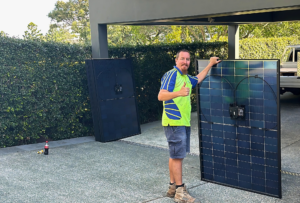
REA Power’s Type X solar panels are built around N-Type cell technology, 0BB architecture and FRC (Fusion Reverse Contact) technology. The bifacial design captures direct sunlight on the front and reflected light on the rear, which can help improve energy generation depending on the installation conditions.
The Type X module uses dual-glass construction and a reinforced frame for durability in demanding conditions. REA Solar lists the panel with efficiency of up to 24.5%, a 25-year product warranty and a 30-year performance warranty.
For homeowners who want module-level optimisation, the Type X range also includes an AC module with an integrated Enphase IQ8HC microinverter. This configuration can provide panel-level monitoring and avoids relying on a separate central string inverter for the module’s DC-to-AC conversion.
The right panel depends on more than specifications alone. Your roof orientation, available space, shading, electricity usage and future energy needs should all be considered. REA Solar can assess your property and recommend a suitable panel and system configuration.
How to Compare Solar Quotes
When you have two or three quotes, compare them on the same basis:
- Panel make and model: Ask for the exact model and datasheet, not just the brand.
- System size and expected output: Compare kW size and estimated annual generation for your roof.
- Inverter: Check the brand, warranty and whether it is a string inverter or microinverters.
- Warranties: Compare product, performance and installation workmanship warranties, and who honours them.
- What’s included: Confirm mounting, switchboard upgrades, metering, monitoring and any battery-ready wiring.
- Installer credentials: Check accreditation, years in business and local reviews. Our guide to choosing a solar installer in Queensland has a 10-point checklist.
- Price after STCs: Make sure every quote shows the price after the STC discount.
Looking at specific panels? See our solar panels page or speak with a Brisbane solar installer about what suits your roof.
Which Solar Panel Should You Buy?
The best solar panel depends on your budget, energy needs, roof and long-term goals. If you want a panel with high efficiency, dual-glass durability and long warranty coverage, REA Power’s Type X is worth including in your comparison, alongside a site-specific system design from your installer.
Ready to compare options? Call REA Solar on 1300 360 047 or get a free quote.
Frequently Asked Questions
What are the best solar panels in Australia?
The best solar panels for your home depend on efficiency, durability, warranty coverage, roof conditions and your energy needs. Rather than choosing a panel based on brand or price alone, compare its efficiency, construction, performance warranty and suitability for your property.
How do I choose the right solar panel for my home?
Choosing the right solar panel means considering efficiency, durability, warranty coverage, cost, roof space, shading and your expected energy use. Higher-efficiency panels can be useful when roof space is limited, while features such as dual-glass construction and bifacial technology may be beneficial depending on the installation.
What makes a solar panel premium or high-performance?
A high-performance solar panel may combine efficient cell technology, durable construction, strong warranty coverage and features designed to improve energy generation. However, there is no single specification that makes a panel the right choice for every property, so the panel should be assessed alongside the overall solar system design.
Which solar panels are best for Queensland heat?
Look for a low temperature coefficient, durable dual-glass or similarly robust construction, and tested hail and wind ratings. Output drops as panels heat up, so a panel that holds its performance on hot days is valuable in Queensland.
Are bifacial solar panels worth it?
Bifacial solar panels can generate electricity from both sides by capturing direct sunlight on the front and reflected light at the rear. Their additional generation potential depends on factors such as panel elevation, roof or ground surface, installation design and the amount of light reaching the rear of the module. REA Power’s Type X is a bifacial dual-glass module.
What is REA Power, and how are its panels different?
REA Power is REA Solar’s solar module range. The Type X Cell Dual Glass Solar Module uses N-Type cells, 0BB (Zero Busbar) architecture and FRC (Fusion Reverse Contact) technology, combined with a dual-glass bifacial design. The range includes a standard DC module and an AC module with an integrated Enphase IQ8HC microinverter.
What warranty do REA Power solar panels come with?
REA Power Type X solar panels come with a 25-year product warranty and a 30-year performance warranty. REA Solar’s Help Centre confirms these as the standard warranties for REA Power solar modules.